Cut half of my income and spend only the other half since I was a first jobber in 18.
Number one and two I followed the example set at home. Home matters. May Allah keeps showering the rewards of all the good teaching from and for my mother . Amiin.
Number three, I didn’t really remember how I started but, having clear goals and three big dreams in my 20s helped me giving clarity and purpose what the money earned for.
I also learn that if you can’t be clear about your own goals, it’s likely to be harder to be clear when it comes to other people.
Doing all the those three since my 20s turned out to be a huge advantage in my 40s. Getting older is unavoidable, but what I just realized getting older comfortably needs more hard work when you’re younger. You’ll get what you pay in your 20s for your 40s. Good things compound, so does bad ones. All the habits done daily and regularly over the years during my 20s suddenly feel easy when I turn 40.
I am often being hard on myself because I know myself too well. I am basically and naturally lazy. But I want to live comfortably. If I keep validating my laziness, it will make life harder for me, so there’s no other way to do the opposite.
This also becomes my stand on raising my daughter. I want my daughter have what I have in this part. Although her life is not mine to live, but I wish her well being, physically and mentally in her adulthood, which means the preparation should start early.
Enjoying my 20s thanks to years of training done since my childhood and teenager years, again credit goes to my mother and for some part, my father.
Now, in my 40s, it isn’t time for relax and easy. It means another preparation should be done for the next two decades. May Allah make it easy, may the mind and heart keep being on the track to live peacefully in this world and hereafter. Amiin.
If I could describe what makes me survive these past 13 years, maybe one of the answers is because we have a functional marriage.
This post has been sitting on the draft since last year (I even forgot what year). I only managed to finish that first paragraph above. Nothing came out after that until today (I also didn’t remember today referred to when).
It took a tweet that triggered me to finish it. Not yet published, but just finish it is good enough.
The job division in this household is quite clear from the very beginning. We only have the three of us at home. So, everyone is responsible for certain things at home other than their personal responsibilities without other people involvement in our daily life.
We started literally from zero as I once wrote here.
I was the breadwinner during the first and half years and slowly the doctor took over. Studying full time as residents in the morning while working part time in few hospitals in the evening. Sacrificing less time for more money. That was why we postponed to have a kid during the first years of marriage.
When the little girl came, I took many steps backward towards working although it means less income. But, the baby doesn’t need two parents who give her money. She needs one to earn the money while the other one to give her their time and energy. So, it’s clear who did which.
Up until the tenth year, the job division is still as clear. Not only for the major thing, but also down to the smallest thing. When the doctor cooks, he needs no help in preparing anything. In return, he doesn’t have to think about anything other than producing meal for us, not the cleaning, not even returning bottles of spices used to its rack. It would be my responsibility, and there’s not much argument about that.
It goes the same with money. One will focus on bring in the money while the other will be focused on managing and allocating the resources to the smallest detail.
This marriage has been like an organization which functioned well because the members contributes different skills needed to run it well. One possesses good hard skill while the other one has the soft skills.
Without money, there would be no single dream checked for the past ten years. Yet, money alone without proper management wouldn’t take us anywhere no matter how much the number has been growing since our first year.
When one has to deal with many things outside, the other one takes care everything inside.
The kitchen analogy describes this well. You need different kind of knives when you’re cooking. You can’t cut the meat with the same knife you use to cut the fruit. You can’t cook the soup with same pan you use to grill the steak. This is basically and exactly what a functional marriage looks like.
It might be not an ideal type of household like other typical Indonesian families where additional helps are available to cover some works. But, so far, this works best for us. It’s not easy but it’s totally doable and I am beyond grateful with what I have.
Personally, surviving life together with someone is not easy. I used a meticulous and detailed process to select candidates for someone who had never dated another person.
Pardon my humble brag, but I had plenty of offers during my 20s.
I can’t imagine navigating adulthood alone. Many things that I want in life can not be done alone, and many things are indeed easier with some companies. Single life might be more simple, but together, you’ll be going much further than you can imagine.
As I grow older, I learn to accept many things through continuous broken-hearted sessions. I learned that you can’t have everything, but you can choose what you can tolerate.
I am strong-minded; not much can break me as long as I know the ultimate purpose of accomplishing something. That includes being married.
I sincerely accepted things that happened, the good and the bad, the best and the worst. I wholeheartedly owned all the highs and the lows. This last line is another joy of growing old, I guess. You can just accept anything without so many excuses, because you know, life goes on.
(The third updated draft after another major issue happened).
Last child lives a soft childhood, the prince or princess of the family, especially when they’re different gender from the older siblings. They have more attention and compassion from the surroundings.
Thus, They’re generally entitled. Maybe because they are here when everything is ready. They mostly don’t go through the lower end of the family history.
They’re more close-minded than the other siblings. I think this is related to the entitlement they carry.
They grow to be an adult who thinks it’s all about them and their problem solving skills are mostly one way thinking.
Disclaimer 2 : back to disclaimer 1
While, the first child syndrome, they are the warrior of the family. The second parent to the siblings, one who carries the most burden, expectations, and responsibility. They mostly have ‘rough and hard’ childhood.
In the other hand, they become an adult who is strong, self-reliant, capable, and emotionally more intelligent than other siblings. They’re real life ready since early. They’re mostly the most ‘successful’ in the family, and it’s not only about material things. First child tends to have solutions to every problems.
But, there’s always price to pay. What doesn’t kill you indeed makes you stronger. But, at what cost? The successful fist child seen from the outside paid with the most innerchild wound inside.
Onlies tend to be the combination of last and first child. As a parent of one, balancing between the two has been the homeworks that I have been working on. Raising the little girl with sufficient amount of last child comfortable life for the basics (although what considered basics in her period is way totally different than one in our period). But, in the other side, treat and push her towards the mentality of first child through the daily activities, regular experience, and setting the right expectations.
As a first child, it’s not really hard to train of what I am and have been through. The most difficult part is to understand something that I am not and I didn’t have growing up. Putting some new perspective inside the mind and consider it as nice thing to have too.
Acknowledged that she doesn’t have to go through what I had been going through to become a functional adult. But, not so much too lenient until she became more of dysfunctional last child who can only deal with anything comfortable.
Where’s the middle child syndrome? I don’t really have so much encounters with middle child. But, one thing that I observe from few families with middle child :
Strong parents usually produce the typical first child. While not so strong parents usually raise a strong middle child. Middle child who try to fulfill the absence of traits that are usually own by the first child.
This is aligned with what my psychologist told me. Unconsciously, every child will take some role in the family they’re born into. So, in some scenarios, if the first child doesn’t take the role of the typical, then other child will take that role, in this case the middle child.
Well, this is a personal ranting, not an empirical study. So, feel free to disagree.
Dealing with three times traffic light in few meters after sending the little girl to the school.
Continous sighing of “I am so tired” due to late night out and late sleep. In my dictionary, late means anything done outside after the maghrib prayer.
Regularly punching my aching shoulder and wonder “should 40 feel this old?”. What is the science behind the decreasing energy as decade passed by?
I wrote those lines above while waiting for one of the longest red lights in the city. I resumed this while waiting for the little girl’s math classin the afternoon.
After school delivery, I had an appointment at nine am and was heading there while whining. This Monday is unusually packed from morning till evening.
I stopped by a supermarket along the way. I planned to visit my parents’ house after the appointment, so I picked some traditional snacks and was quite happy with my choices for today: a pair of Lumpur surga, a pair of Dadar unti, a pair of lalampa, and a pair of panada—two pairs of sweet snacks and two pairs of savory ones. It’s Monday and Sunnah fasting day, so those were good selections for Iftar.
Besides snacks for my father, I bought a pack of Santang Honey tangerines for the house assistant who has been staying with us for 29 years, along with the Eid money I had prepared for her. It was a long overdue Eid money. Making time, space, and energy for something that is not really compulsory requires a high level of intentionality, and that is not easy. I already felt so guilty for continuously postponing the visit.
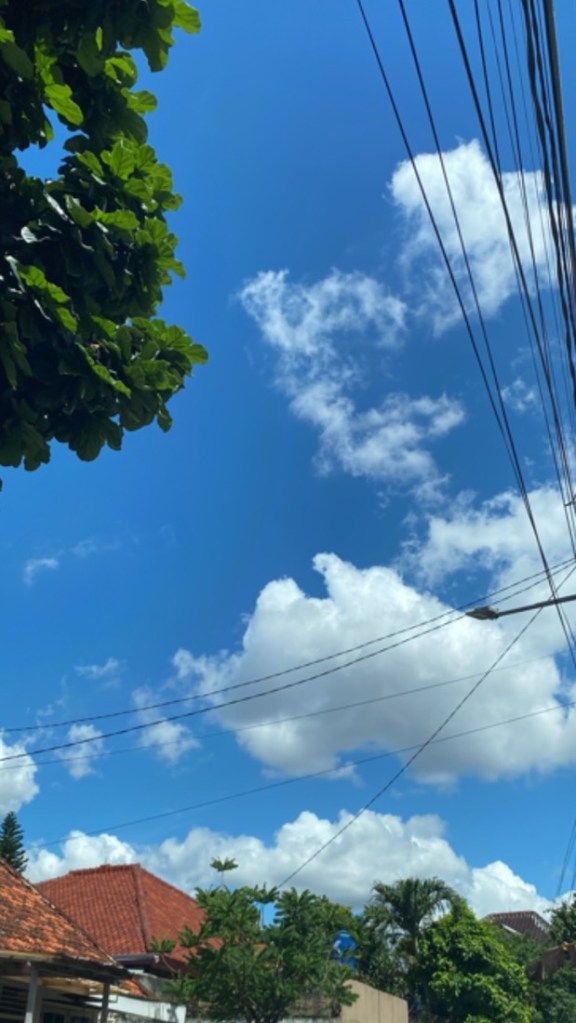
It was great view with blue sky and white clouds from where I sat behind the steering wheel. It makes the heart slightly lighter when the weather is nice and there was an inexplicable feeling that today’s meeting would be a good one.
I have been thinking about this particular matter related to the tiny business since a few years back, but again, there is not enough time, space, and energy to really consider it. Staying within the status quo has been my escape.
But last Ramadan, I still remembered how it went. It was like being struck with lightning. I sat at my dining table and suddenly had an idea. Looking at the maps and texted few possible scenarios in my head. After years of doing nothing, I finally took the first step toward change.
The idea was a bit unusual, but trying wouldn’t hurt. Surprisingly, I got answers, although many were not what I hoped for. A few declined, and one answered with a chance of good news. I set up a meeting, asked many questions, and returned a few times, but something didn’t click. No matter how often I imagined how it would be going, I couldn’t feel certain.
I went back and forth by this option. I kept questioning whether it was just really unfit or just another excuse that had been around for years. The hardest one to beat in life is no one, nothing, but my mental block inside.
I seem to be less courageous as I grow older. Staying wrapped in comfort is indeed addictive.
In between thinking and considering, we visited another option but it was even more unfit.
The idea keeps lingering, until last Saturday, I took my time, driving alone in the morning to drop some equipment and picked my daughter’s bag.
The road was empty so I could drive slowly, hoping to notice something that I have been missed before. I have this certain restrictions that I always set for almost everything that I want. So it makes the options limited and I rarely want to compromise. I’d rather wait.
When I took the u-turn, passed a convenience store, and kept driving slowly on the left, I saw a small banner with a tiny phone number. Unfortunately, I couldn’t take a picture or note it down since it was so small. I was hesitant to return because I still had to be in another two places after this. I need to go through a bit circling once again to get the number.
But, this time, I told myself, if I didn’t, I might regret it. This might be another chance that could work. So, I did
Got the phone number and asked right away. Along the way I started compromising my restrictions to have more options. I captured three more phone numbers and asked right away too.
Not long, all came with answers. The only positive answer came from the one whose number I got with an extra effort. Set up an appointment on Monday.
I almost cancelled today’s meeting due to the low energy since the moment I woke up until the moment I typed the first three lines ranting above. I already thought to send a text that I had to cancel, but, some guts said “just don’t, come on!”.
Usually, I tried to use as much as my logic for everything. But, it was hard to deny the good feeling inside about the meeting. When I arrived, met the couple, saw it with my own eyes, it reminded me of the first time I saw our current home, our place in London, our current business place, the red English garden bench, all the things that I have been looking for and need to wait for a while until I found them.
It felt just right.
The rest of the day was spent by discussing things with the co-owner, texting few other people that came to my mind regarding the matter, and suddenly I feel like finding a new purpose for living. Sounds joking but it’s true.
Other than the technical and non-living things, I always consider the kind of people I deal with. I like the people I met today, and I think they like me too. The deal has been done in less than 24 hours. No matter how convincing it feels, entering a new phase is still frightening. The sign : countless repeated Bismillah over and over again, consciously and unconsciously.
At times like this, my thoughts always return to The One Who Decide all affairs. All the sequences that doesn’t seem make sense, but happened. All the knocked doors seem to be voluntarily closed and only open for the right one. All the little things that send me to the particular place or things has one similarities : it happens so fast.
The waiting has always been worth it.
This Monday also marks the end of the fasting marathon during the past two weeks.. Five days of Qadha, and today was all the three Sunnah fasting altogether: Syawal, Monday sunnah, and the last day of white moon. The hardest fasting is always those are done after Ramadan. Alhamdulillah for the chance to complete it all.
On my mother’s hometown, after completing six days of Syawal, there is this second Eid called Lebaran Ketupat and it is celebrated quite loud too.
We had iftar at our old home in the mall in one of Indonesian restaurants with wide range and good selection of food and traditional snacks, and they just officially got a halal certification! Another good news that made me happy too.
(I don’t really fond of having iftar outside, it’s tiring. But, the little girl’s had a dentist appointment there and it was too close to iftar time. When it comes to iftar, I always crave for Indonesian food. Another restriction set by me for me).
This Monday looks and feels like another Eid. Literally and figuratively.
Taqabbalallahu Minna wa Minkum Shiyamana wa Shiyamakum (May Allah accept our fasting for you and us).
Eid Mubarak!
The clear blue sky of Monday
(Writing about the mundane events of daily life is underrated. This Writer said it well).
This Eid, I met two lifelong friends (separately) We have been friends since elementary school (1992) and junior high school (1997).
We did not communicate intensely throughout the years, but once we met, everything just flowed naturally—like two people who have known each other for a lifetime.
Three hours of conversation catching up with life, and no single picture taken, no tag or mention needed. This is a lifelong, low-maintenance friendship that makes the heart whole.
After the first half, Ramadan flew by. I had my period nearing the last 10 days, and once I could resume fasting, a sudden change of routine was on.
The Tarawih trip was a spontaneous decision made right after Iftar on the first day I resumed fasting after the period ended. We usually do tarawih at home together. But, I wasn’t really sure what happened, but the idea suddenly popped into my mind.
Maybe we didn’t have to rush early after school because school was already on holiday. Perhaps I crave something more special on the last 10 days of Ramadan.
I enjoyed the six-day tarawih trip we did. We went to six different mosques, each around 5 km from home. We left after iftar and Maghrib and then drove to the mosque. We once spent iftar outside to get close to the mosque chosen that day. It confirmed that I loved tarawih out but not iftar outside. Iftar out is more tiring than doing twenty rakaat of tarawih.
The first day of Eid was spent doing the essentials from morning to evening, and it was tiring. The second day of the Eid holiday was spent resting at home and catching up on some unfinished work. A rest day is much needed before upcoming appointments on the following day. I have also already resumed fasting for Qadha and Syawal, insya Allah.
Fasting after Ramadan is hard, but postponing it is not a good option either. Many years ago, I tried to finish all the mandatory sunnah fasting before the next period. I feel safer and more peaceful fasting than having days of feasting.
May Allah receive all the Ramadan fasting and worship done, and may it be easier to complete all the following fasting. Amiin.
I have been enjoying this Ramadan, most of the time, at home. No iftar outside up until half of the holy month which I am so grateful for.
The last time I really enjoyed iftar outside was around 2012. After that, I won’t trade anything for iftar at home and it’s getting stronger as I grow older.
Since 2019, I have totally different Ramadan experiences than I did from childhood until 2018. Raised by highly extroverted parents who are always opt to loud Ramadan, I finally found kind of Ramadan that suits me most.
The quiet, the peaceful, and the simple one.
Realizing that the most comfortable iftar done is one you do at home, wearing your comfortable clothes, with a simple meal. No food spread on the table for iftar. Just a decent meal to fill the stomach and one or two snack. Short break after maghrib and before tarawih in silence, then tarawih at home, and bed time at 9-9.30 pm so you can wake up early for tahajud and sahoor.
This might sound boring, but, personally, this is the key to stay healthy and happy all through Ramadan.
This Ramadan, I clipped more routines to prayer times and so far it works pretty well. I love that I have something better compared to last Ramadan. I read more about Islamic scholars books, and I think it’s a blessing that knowledge is really everywhere these days.
Halfway thorough Ramadan, may we all be granted all the blessings and the strong finish at the end of the month. Amiin.
Since finishing The Defining Decade last year, one word has been playing inside my head.
One word that seems to make sense is to explain why people get what they want, achieve what they strive for, and what separates them from those who don’t.
In Ramadan, I know some people/businesses that close fully for the whole of Ramadan, finish the Quran and do many other things that I once wondered how they could do.
Among many words that could explain contributing factors to the cases above, first and foremost, it starts with one thing :
Intention. Those people above are all being intentional in the first place.
They know what they want to do and achieve; they know Ramadan is coming, so they’re intentionally preparing for it.
When we are intentional, we choose to make decisions and take action on what’s important to us. Being intentional means getting clear and upfront about what you want to achieve. We intentionally set an intention to achieve a specific outcome or result in the future that is important to us.
Setting goals without the proper intention won’t take us far and long. That explains why many New Year resolutions fail, diet regimes lasts for a while, and many more. When we only hav goals, we only play for a short term. But, when we’re being intentional, we’ll keep playing no matter what.
It also makes sense why In Islam our reward is only as good as our intention. It emphasizes being intentional is the foundation of all the deeds that we do.
Our Ramadan and our life in general, here in this dunya, and later in the hereafter, is only as good as our intention.
For up to 10 days, there’s a single line that I repeat to either my daughter or her father whenever we’re out : “Why is it so empty and quiet?”
This Ramadan is unusually quiet and less crowded than before. In a regular pattern of numerous past Ramadans, in the morning, the traffic would be getting crowded, like really crowded, around 7 to 9 am. But, the trip to school for the past 10 days has been the most enjoyable. I cursed less than before, apart from refraining due to fasting.
That’s weekdays. I was driving thrice last Saturday. In the morning, it was empty. Okay, it’s normal for Saturday morning roads in Ramadan to be empty. I went out the second time at 11 a.m. for swimming practice. It was still empty, slightly. It only took 10 minutes to go to the pool. What’s more unusual, it took around 10 minutes to go home from the pool, which normally takes at least 20-30 minutes.
Then, we went out again around 2 p.m. for a therapy session. I overslept and thought we would be late for 2:30 p.m. We left at 2.10 p.m. and arrived leisurely at 2.27 p.m.
The most weirdest thing of all, when we went home around 4 pm, the traffic was as leisure as the departure. Slightly more crowded, but that was not the typical Saturday traffic in Ramadan, at the beginning of month.
Saturday in Ramadan has always been the time when people go out to have an iftar gathering. Usually, we need to go out and book a table as early as 4 pm and the traffic has always been crazy.
Yet last Saturday, there was close to zero traffic. The traffic has never been this good, yet I felt so bad.
Another regular I don’t see much this Ramadan is a blewah and timun suri ( cantaloupe and a kind of cucumber fruit only available in Ramadan) seller. They are a significant component of the Ramadan vibe around the town. Usually, a few days before Ramadan starts, we can see both fruits everywhere.
This Ramadan, I hardly see any.
I went to a traditional market today, which was as quiet and empty as possible.
Ramadan is the most festive season of the year, but it feels like we have a silent Ramadan this year. Unlike in 2020, when it was tense due to COVID-19, this year it feels more unlively and, say, a bit depressing and gloomy.
The country’s current situation is undoubtedly not at its best.

 A Penny for My Pensieve